|

One Page Poetry Circle Archive
Welcome to the One Page Poetry Circle!
Date: March 17, 2026
Theme: Occasional Poetry
Time: 5:30 – 6:30 pm
Place: St. Agnes Branch Library, 444 Amsterdam Ave, 3rd fl. Or by email (see addresses below).
Find a poem! Show up! Or send a poem by email!
We're back for the 18th spring season of the One Page Poetry Circle where people examine the works of established poets. While there is no instructor and this is not a workshop for personal writing, once a month OPPC gives everyone a place to become teachers and learners to explore the form, content, language and meaning of poetry. Since the circle began, participants have selected and discussed 1798 poems and have read countless others in pursuit of poetry that speaks to them.
GOOD NEWS: The One Page Poetry Circle has returned to the St. Agnes Library.
In addition, for those who are unable to attend, you can still participate by email.
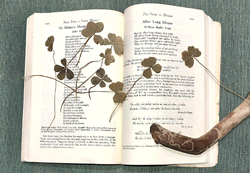
Our topic for March 17th celebrates St. Patrick's Day by considering Poetry and the Irish. Is one of your favorite poets Irish or does a poem you read mention something Irish?
Many of the earliest Irish poems were written by monks in the margins of Latin manuscripts they copied. Here for example, is "Viking Terror" written near Bangor 1200 years ago, in translation by James Carney. (Click on title to view the page where it appears, in the upper margin):
- Bitter and wild the wind tonight
- tossing the tresses of the sea to white.
- On such a night as this I feel at ease:
- fierce Northmen only course the quiet seas.
The Irish have an old tradition of poignant ballads dealing with hardship. "The Fields of Athenry" by Pete St. John, a modern version of an old ballad, concerns a young man caught for poaching food to feed his family and deported to Australia during the Great Famine.
- By a lonely prison wall, I heard a young girl calling
- "Michael, they are taking you away
- For you stole Trevelyan's corn
- So the young might see the morn
- Now a prison ship lies waiting in the bay"
We met on February 17 for an outpouring of poems for the theme Poetry and Walking.
Donald opened the circle with a famous W. H. Auden poem "As I Walked Out One Evening," in which the narrator goes into the city and hears a lover singing his heart out that "love has no ending," only to be interrupted by a clock, which clears its throat as if to remind us about time and our mortality: "But all the clocks in the city/Began to whirr and chime:/'O let not Time deceive you,/You cannot conquer Time.'"
Gail followed with "The Summer Day" by Mary Oliver in which the poet—on a walk through fields—asks broad questions about life, but then gets specific as she observes and interacts with a particular grasshopper living in its own way:
- Who made the grasshopper?
- This grasshopper, I mean—
- the one who has flung herself out of the grass,
- the one who is eating sugar out of my hand,
- who is moving her jaws back and forth instead of up and down—
- who is gazing around with her enormous and complicated eyes.
Karen selected an Emily Dickinson poem "I Started Early," which tells of a walk on the beach during an incoming tide. In describing the chase of the water, the poem alludes to a sexual pursuit: "But no man moved Me—till the Tide/Went past my simple Shoe—/And past my Apron—and my Belt/And past my Bodice—too—"
Jennifer read "The People on the Bridge," an ekphrastic poem by Wislawa Szymborska: "It's difficult at this point to keep from commenting./This picture is by no means innocent./Time has been stopped here." The poem references a Japanese woodblock print depicting people caught in a moment of time as they shield themselves and scramble to get out of a sudden downpour over Shin-Ohashi Bridge.
Greg selected a Robert Frost sonnet, "Acquainted with the Night," in which the poet speaks of extreme isolation and loneliness as a condition of being human. The poem begins and ends on the same line: "I have been one acquainted with the night." The repetition of the line underscores both the literal and the figurative and that there is nothing to be done about it.
Julia delighted us with the alliterations and lush metaphors of "Walker Creek: November" by Peter Davison, which begins:
- Now swift swallows have flown for the winter.
- The last pears have fallen.
- Maples, huddled close in the swamp,
- slip off their leaves
- and lay bare the shaggy cliffwall.
Sarah brought the second Mary Oliver poem of the evening, "When I am Among the Trees," in which the narrator, a solitary walker, professes her gratefulness: "When I am among the trees/especially the willows and the honey locust,/equally the beech, the oaks and the pines,/they give off such hints of gladness./I would almost say that they save me, and daily."
Nancy read us "I Wandered Lonely as a Cloud" by William Wordsworth, first mentioning that she chose it because this time of year is usually when daffodils emerge—but not this year:
- I wandered lonely as a cloud
- That floats on high o'er vales and hills
- When all at once I saw a crowd,
- A host, of golden daffodils;
- Beside the lake, beneath the trees,
- Fluttering and dancing in the breeze.
Diane chose "Brief Thoughts on Maps" by Miroslav Holub from 1977. The prose-like poem tells of a fighting unit of men finding themselves lost in the Alps without a map to guide them. When someone finds a map in his pocket, they all relax and discover their whereabouts which saves them. Ironically: "The lieutenant borrowed this remarkable map/and had a good look at it. It was not a map of the Alps/but of the Pyrenees."
Cate read Kelli Russell Agodon's "Hunter's Moon," one of several poems that evening with references to the moon as a time piece, illuminator, and symbol of loneliness. The poem begins:
- The first person you fall in love with
- will be a deer. You will want to cradle him,
- but his instinct is to vanish. Scuttle. Scurry.
Christiana brought "Traveler, There Is No Road" by Antonio Machado. We were treated to a reading in both Spanish, the language in which the poem was written, and an English translation by Mary G. Berg. The poem addresses the reader: "Traveler, your footprints/are the only road, nothing else./Traveler there is no road;/you make your own path as you walk." The poem ends by reminding us that our path is: "only a ship's wake on the sea."
AnnaLee brought the circle around with poet and novelist Robert Graves' "Not Dead," which relates a narrator's walk through the woods for solace after the death of a comrade in WW1. Rather than railing against war, the poet finds evidence of his friend in nature: "Caressingly I stroke/Rough bark of the friendly oak./A brook goes bubbling by: the voice is his./Turf burns with pleasant smoke;/I laugh at chaffinch and at primroses." The chaffinch is a bird with an epaulet pattern on its wings.
Abigail was struck by the rhythmic resignation of Alfred Lord Tennyson's "A Farewell": "Flow, softly flow, by lawn and lea,/A rivulet then a river:/Nowhere by thee my steps shall be/For ever and for ever."
Roger discovered William Wordsworth's "An Evening Walk" in which the poet describes the changing view of day in rhymed couplets while walking in his beloved Lake District: "Far from my dearest Friend, 'tis mine to rove/through bare grey dell, high wood, and pastoral cove."
June sent another poem by Wordsworth, a sonnet, "Most Sweet it is," liking "best the equivalence and acceptance of 'if path be there or none' and 'The beauty coming and the beauty gone'": "Most sweet it is with unuplifted eyes/To pace the ground, if path be there or none,/While a fair region round the traveller lies/Which he forbears again to look upon."
Scott wrote that "after gagging on a number of poems rhapsodizing about the felicitous effects of walking, I was pleased to find 'Acquainted with the Night' by Robert Frost, which takes a more depressing view": "I have been one acquainted with the night./I have walked out in rain—and back in rain./I have outwalked the furthest city light." Scott mentioned that "Intrigued by the few lines quoted from the Judith Viorst poem last month (chalk one up for the Circle) I read the whole collection." In a rare occurrence two people selected the same poem, but each with their personal point of view.
Carol felt moved by Rose People's "A path of stars" in her grief for her sister, Nancy Rita Wolfe, May 9, 1950-January 24, 2026: "My darling,/I can only wish/when you walk through the dark and tangled forest/and lose your way a thousand times/that one day/you come across a clearing/
where you can sit/and where the sun will find you/and warm your face/and you can rest."
And one more that didn't make it into December's notice on the subject of Poetry and The End: Susan sent Gregory Orr's "To Be Alive," saying "For me, the poem is so positive, no matter what your point of view of this life trip."
- To be alive: not just the carcass
- But the spark.
- That's crudely put, but...
- If we're not supposed to dance,
- Why all this music?
If you can make the March 17th meeting, we ask that you bring a Poem concerning or by the Irish, with copies for others if you can.
If you're unable to attend, send us the poem you've selected with a comment on why you chose it. We'll share the poems with you by email and through our blog.
Choose a poem that is meaningful to you. Can't locate a poem you want to send? TryPoetry Foundation or poets.org. In the meantime, blog with us at onepagepoetrycircle.wordpress.com.
Spring 2026 Schedule
March 17: Poetry and the Irish
April 21: Poetry and Dance
May 19: Poetry and Poetic Devices
Abigail Burnham Bloom, abigailburnhambloom(at)gmail(dot)com
AnnaLee Wilson, annalee(at)kaeserwilson(dot)com
The One Page Poetry Circle is sponsored by the New York Public Library and is open to all. St. Agnes Branch Library is handicap accessible.
|


